
We explored this through the programmes of this year’s TeatRom Festival and the project’s closing conference, which marked an important milestone in the three-year SPARSE Plus project. Both the personal experiences of project manager Annamária Jacsó and the insights of community development expert Márton Beke demonstrate that the power of culture extends far beyond the performances themselves.
Annamária Jacsó, the project manager, recalls the most memorable moments of the TeatRom Festival and the closing events through her own personal experiences.
I’m originally from Borsod, a region in northeastern Hungary. I grew up here and spent my university years in Miskolc, the region’s largest city, yet somehow I had never visited the villages where the TeatRom Festival took place. It wasn’t because of any negative feelings or prejudices – I simply never had the opportunity. This time, as the organiser of the SPARSE Plus closing conference and the project’s final international partner meeting, I had the chance to get to know these villages and their communities a little better.
My first encounter was in Alsóvadász, a small village near Miskolc. I arrived by car, and even before reaching the venue, I was welcomed by smiling local volunteers in yellow vests. They enthusiastically guided arriving guests, showing us where to park and how to find the performance venue. These were simple gestures, but they immediately made me feel that something special was happening here, and that our presence was genuinely appreciated.
The audience was already gathering inside. So many curious eyes, people shifting in their seats, a sense of excitement, anticipation and pride. We were about to watch a staged reading of Cigányváros (Gypsy Town), featuring local children alongside amateur and professional adult actors from the TeatRom team.
What struck me most wasn’t necessarily the story itself, but the way everyone was so fully engaged. The way they paid attention to one another, how carefully the children tried to deliver their lines, and how the adult actors supported them. Some read from their phones, others from sheets of paper. For me, this didn’t take anything away from the performance. Quite the opposite: it made their dedication even more visible. They wanted to get it right. What they had created mattered to them, and they wanted to share it with others.
Everyone in the audience followed the performance closely. They weren’t simply watching a play; they were watching their own children, friends and neighbours on stage, witnessing the results of something they had created together. The performers’ excitement and the audience’s pride seemed to come together.
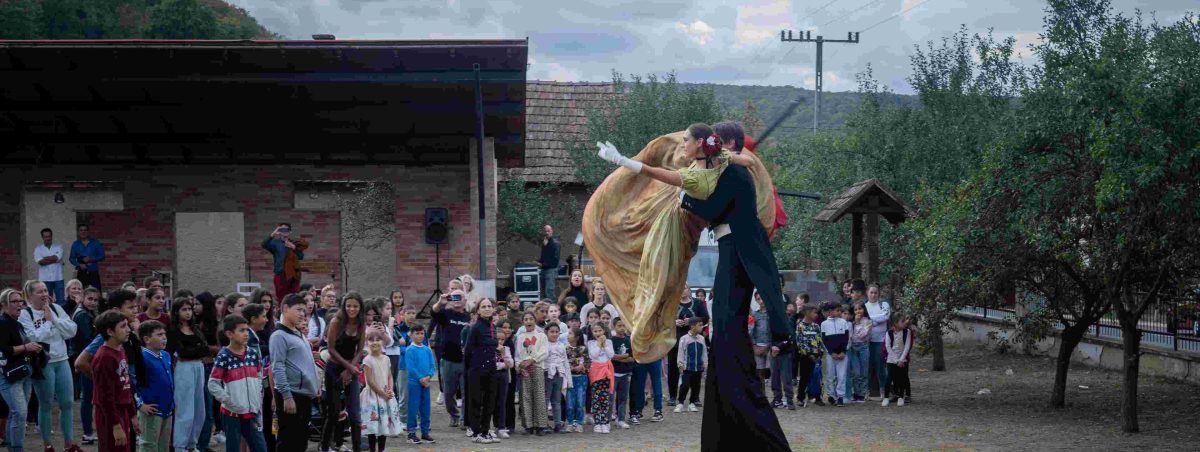
Later, the audience gathered around the outdoor stage set up in the courtyard. Local families, children, young people and older residents sat and stood in tightly packed rows. The instruments brought by the Italian theatre company Teatro Tascabile di Bergamo, especially the drum kit, attracted a lot of attention. One little boy was clearly eager to give the drums a try. Instead, I encouraged him to dance on stage first and wait for the musician to play the instrument himself.
What stayed with me most was the expression on the children’s faces when they had the chance to step onto the stage. There was joy, excitement and pride all at once. That special kind of happiness that comes from feeling seen, knowing you belong, and discovering that what you do matters to others.
On Thursday, the programme continued in Miskolc, where I had a very different role to play. As the organiser of the SPARSE Plus closing conference, my attention was mainly focused on making sure everything ran smoothly: the participants, speakers, programme, technical arrangements, and all the small organisational details that go into an international event.
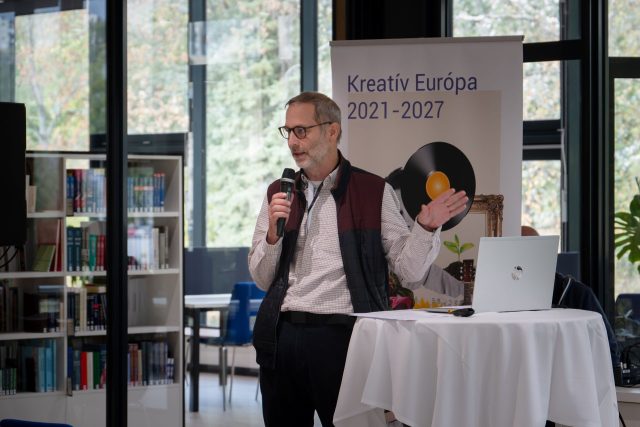
The conference gave project partners an opportunity to look back together on three years of work, reflecting on achievements, challenges and lessons learned. Throughout the presentations and discussions, one question kept coming up: what does access to culture really mean for rural communities?
On Friday, in Szendrőlád, another village in northeastern Hungary, I experienced that same sense of community once again. During the local talent show, Ki mit tud? (literally, “Who Knows What?”, a popular Hungarian format where participants showcase their talents), children and young people took to the stage not only with individual performances but also in groups. They recited poems, sang and danced. The audience’s attention and encouragement seemed to give the performers even more confidence and energy. It was wonderful to see how naturally they cheered each other on, how much their shared success meant to them, and how much joy they found in performing.
I was especially happy to see how much our international guests enjoyed the programme as well. Here, the participants of the international conference could experience the project’s achievements not only through presentations and professional discussions, but by meeting the communities who had been at the heart of the project and actively involved in its activities.
By the end of the day, the atmosphere had become wonderfully relaxed and joyful. The boundary between the stage and the audience seemed to disappear. We danced and sang together, and before we knew it, the courtyard was filled with the sounds of the Italian songs Lasciatemi cantare and Bella ciao. Locals and visitors alike – at that moment, it no longer mattered where anyone came from. We were simply together, sharing the same experience.
For me, this was perhaps one of the most beautiful moments of the entire week. While organising the SPARSE Plus closing conference and international partner meeting, I often found myself focused on tasks, deadlines and problems to solve. But these encounters reminded me why it is worth putting so much energy into a project like this.
It’s not only about bringing theatre performances to places where opportunities to experience live theatre are limited. It’s also about enabling local communities to become active participants in cultural life, giving children the chance to experience the joy of performing, and creating encounters and connections that may stay with us long after the project itself has come to an end.
Behind the TeatRom festival’s communal experiences, a longer-term process also emerges: culture not only fosters encounters, but can also serve as a means of strengthening local communities. But how can long-term collaborations be built on these encounters, and what can endure even after the project has ended? Márton Beke, an expert in community and local development, shares his experiences from SPARSE Plus and his thoughts on the project’s outcomes.
I joined this year’s TeatRom Festival in Alsóvadász. When we arrived, the performers of “Cigányváros” (Roma town) were already getting ready for a stage reading. They had been rehearsing for four days, bringing together children from the village and amateur and professional adult actors from the TeatRom team. As the start approached, there was a sense of excited anticipation, punctuated by the occasional nervous laugh. Then the play began. Balázs, the director, was giving the actors instructions – which is perfectly acceptable during a stage reading. But this actually made the play feel even more alive. It is an inspiring story about a good-hearted nobleman, Archduke Joseph, who wanted to settle the Roma, who were still travelling at the time. He offered the children a school, the adults work, and the community a town of their own. The initiative met with limited success, yet the lessons it offers remain relevant to this day. After the performance, we discussed these lessons with a few local residents. Would a Roma town be a good thing today? What are the benefits and challenges of Roma and Hungarians living together? What does it take to live a decent life, and what brings to the surface the tensions lurking in the deeper layers of society?
The next day, we were in Sajókaza. Loads of children were waiting for Ki, mit tud? (Who Knows What? – talent show). Some were there to perform, others to cheer on their friends. We invited two actors from Teatro Tascabile di Bergamo to join the judging panel, and they were enchanted by the children’s courage and their love of being on stage. The Italian company’s performance, held in the enclosed space of the local community centre, was even more powerful than it had been the previous day on the open-air stage in Alsóvadász. As the children and their parents eagerly awaited the results of Ki, mit tud? (Who Knows What? – talent show), they laughed heartily throughout the performance, while we, as the judging panel, tallied up the scores of dozens of performers. Once the results were announced, the crowd quickly dispersed. Understandably so: it was getting late.
Thursday was also the day of the SPARSE+ closing conference. While the Ki, mit tud? (Who Knows What?) talent show competition was taking place in Borsodbóta amid rain that alternated between drizzle and downpours, alongside another performance by Teatro Tascabile di Bergamo, we took stock of the achievements, joys, challenges and solutions of the past three years. The performances and discussions at the conference were exciting, but the dinner conversation was even more so. Among other things, we talked about the purpose of everything we had achieved through the project. Was it to bring more theatre performances to rural communities? To help more people encounter theatre? Or, ultimately, to contribute to a more collaborative society – one where people can discuss shared concerns, where individual performances become catalysts for conversation and collective action, and where communities can reflect together on what they have accomplished? So, is theatre the goal or the means? In this discussion, we cast our vote for the latter.
The final day, Friday, brought a rousing closing party. In Szendrőlád, as every year, more than a hundred people turned up to watch the performance. Before that, there was another edition of Ki, mit tud? (Who Knows What? – talent show), featuring not only solo acts but also group performances: poems, songs and choreographed routines. Some performers were called back for an encore by the audience. Local stars were born – or perhaps they had been born some time ago and were simply taking the stage once again. Teatro Tascabile di Bergamo was a huge hit here, too. From the benches at the front of the stage, you could barely see the performance because so many people had crowded in front of it. They were laughing and screaming. Next up was Konzi Rajkó’s band, followed by Kálo Drom. For me, this year’s TeatRom Festival came to an end with all of us singing along with them.

SPARSE Plus is a project co-funded by the Creative Europe programme of the European Union.